Franchise Marketing
The Michelin Playbook: What 4+ Years of Franchise Dealer Marketing Taught Us
By Jan RohwederFounder of OnEveryMap · CEO & Founder of Marketing Bear
Insights from Jan, founder of OnEveryMap and CEO & founder of Marketing Bear.
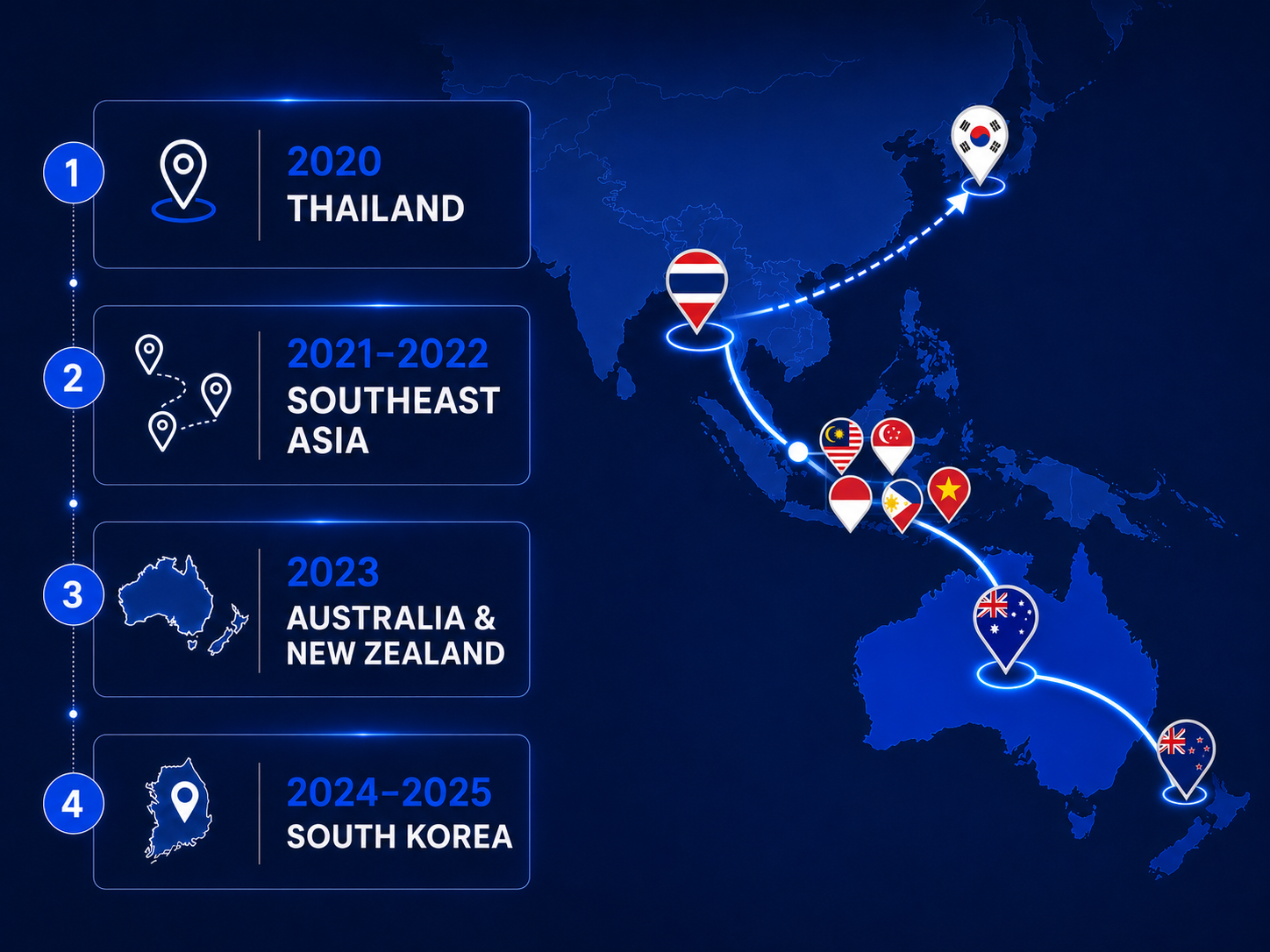
In 2020, a marketing manager at Michelin asked us to help their tyre locations become more visible on Google. Five years later, that single program in Thailand has grown to cover most of Southeast Asia, plus Australia, New Zealand, and up to South Korea. Along the way it taught me more about franchise marketing than any course or case study ever could, because the lessons came from real dealers, real store owners, and real money moving through real businesses.
This is the strategy layer: how you design a franchise marketing program, how you get every layer of a franchise network to actually adopt it, and why doing this well makes your franchise offer harder to walk away from. I'll share the numbers I'm allowed to share, and I'll be honest about what didn't work.
I'll say up front why this matters for franchisors here specifically. In our own 2026 research into Thai franchise brands, we found 124 that were effectively invisible on Google Maps and 2,151 individual locations with no website link on their profile. Those are customers walking past the door. Most of the Michelin playbook below is about closing exactly that gap, at scale, without burning out the people who have to run it day to day.

It started with a franchisor who had already done the hard thinking
The program didn't start with a cold pitch. It started with a relationship. The marketing manager who approached us, Craig Burton, had worked with our team before at a large hotel and tourism group in Thailand, so he already knew how we operated. Credit where it's due: by the time he called us, Craig had already built a genuinely good structure for the kind of program he wanted to deploy across tyre locations. What he needed wasn't the idea (he had that), it was an execution partner willing to adjust the way it works to fit Michelin's setup.
That's the first lesson, and it's a strategic one for any franchisor reading this: the best franchise marketing programs are co-designed, not bought off a shelf. The franchisor owns the network, the relationships, and the reasons a program has to work a certain way. The agency owns the craft and the willingness to bend its process around your reality. Neither half is enough alone.
For us the timing was almost uncanny. Local SEO and marketing strategy were the two pillars we'd already identified back in 2018–2019 as the direction we wanted Marketing Bear to head into, because we could see the need coming, with more and more people in Thailand living inside Google Maps. So when Michelin asked, we didn't have to invent a new competency. We had to prove one at scale.
We launched in Thailand only. Once it was live, we kept finding ways to make it better, and that success is what earned the expansion into new countries, one market at a time, on the strength of results.
What the program actually was
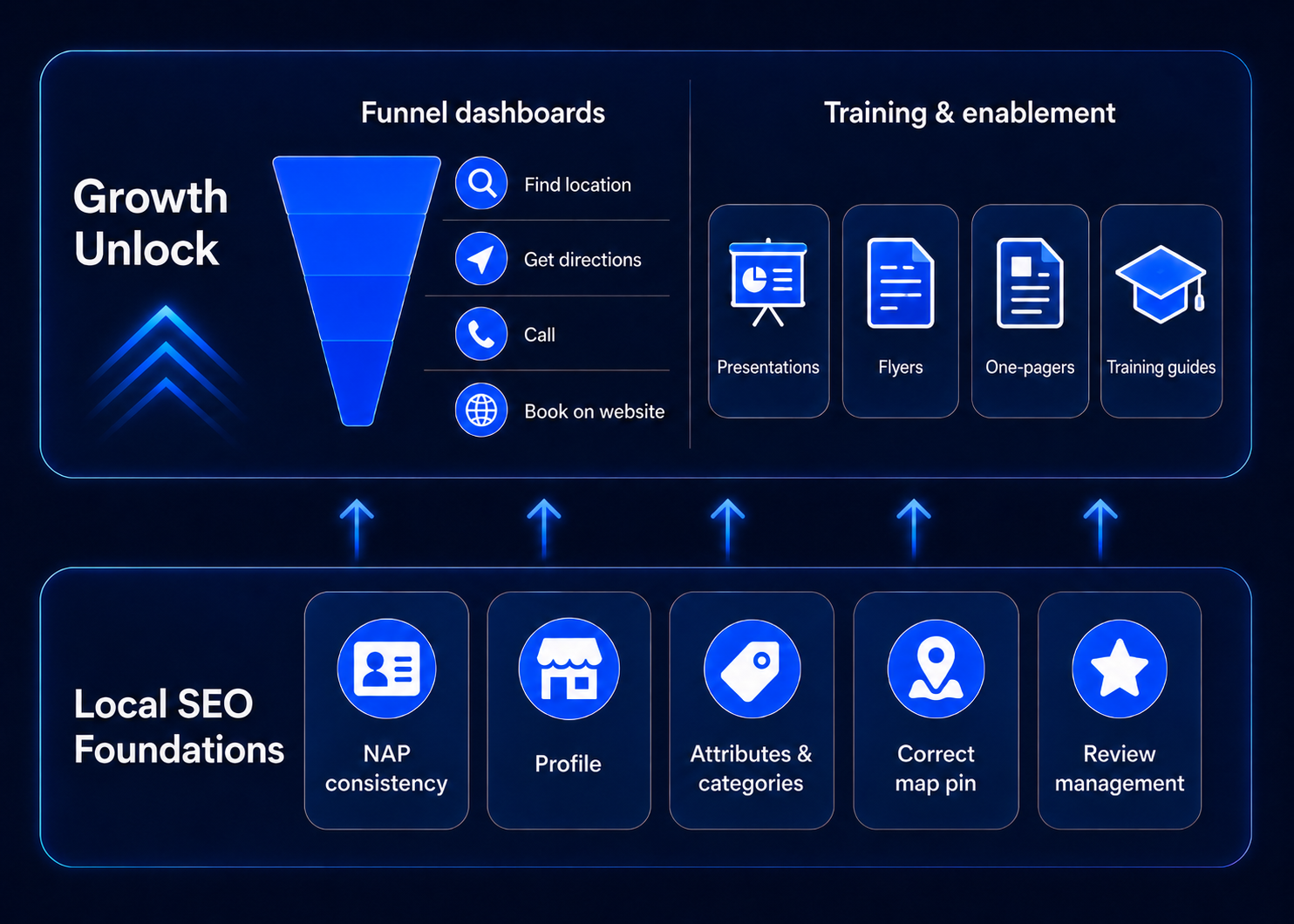
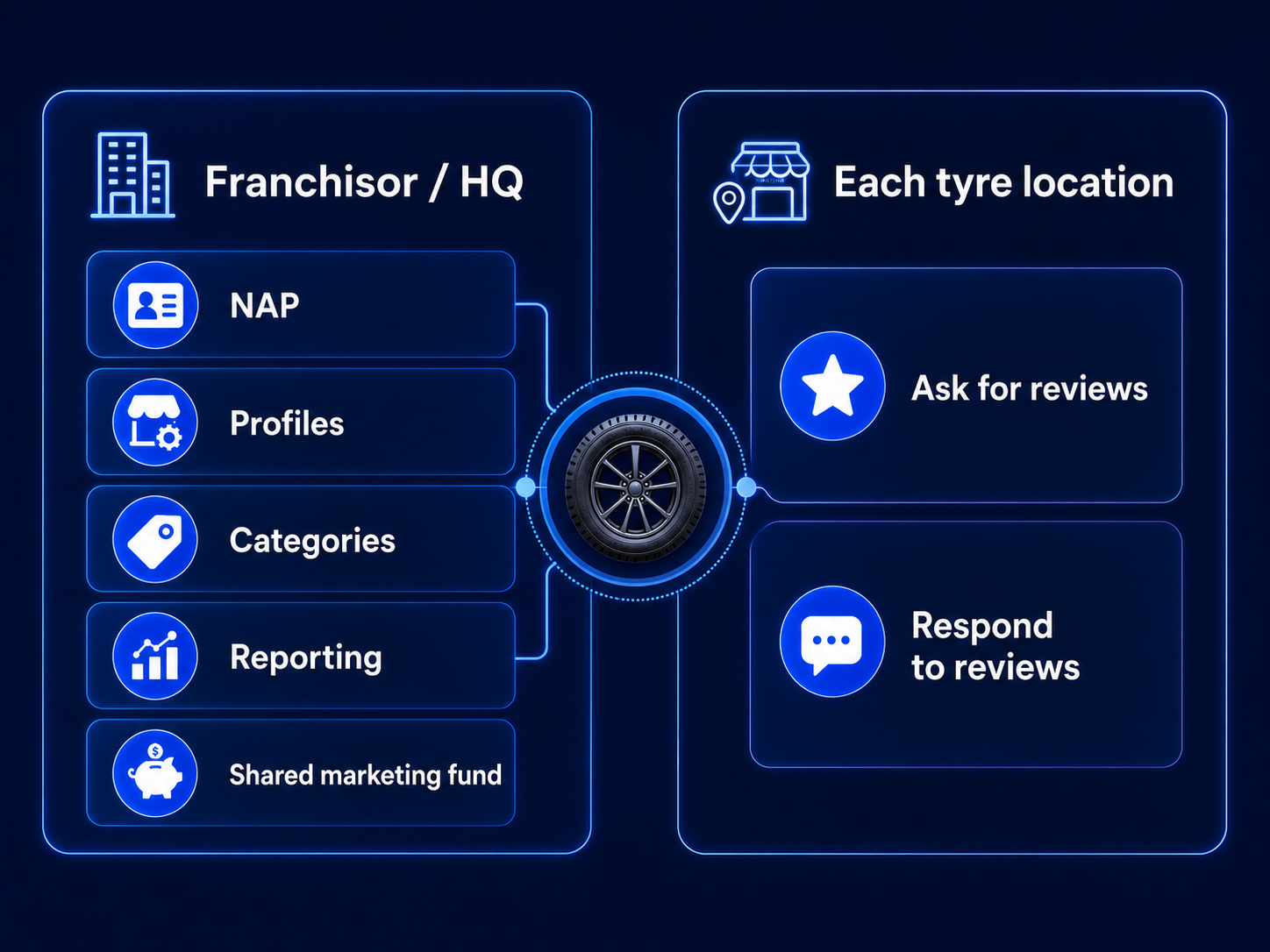
The original brief was, on paper, classic local SEO. Name, address and phone number (NAP) consistency across every location. Profile updates: posts, service and attribute updates, correct primary and secondary business categories. Making sure the map pin actually sits where the store is. And review management. From day one we ran on a rhythm of monthly and weekly meetings on different topics; early on those were mostly about getting the foundations right.
But "the foundation was there" is not the same as "the work was done." Craig had identified all the tasks, but the training materials for the store consultants didn't exist yet, and we had no proper reporting, no agreed answer to the most important question a franchisor will ever ask you: how do we actually know this is working? There were a lot of moving parts.
So year one was foundational and unglamorous: NAP, profile optimisation, the right categories and attributes, correct pin locations, then posting and review management: content written once and customised per location with the right store name and number. (A small note for the strategists: back then Google still let you track views and interactions on posts, and it didn't penalise near-duplicate content. Both have since changed. But there's a brand-experience argument that outlives the tactic: when every location's profile feels connected rather than orphaned, it quietly reassures the customer that they're dealing with one brand, and that helps their decision.)
The real unlock came in the second layer. Over the years we drove harder and harder into reporting, building custom Power BI dashboards that showed the whole funnel: how do people find each location, and are they tapping "get directions," calling the number, or going through to book on the website? And alongside the dashboards, we built the marketing and training material (presentations, flyers, one-pagers) so that everyone from the regional store consultants down to the person in the shop asking for a review had the same information and understood why we were doing this.
That second layer is what unlocked heavy growth, and it's the lesson I'd underline twice: the deliverable that scales a franchise program isn't the SEO task, it's the material that makes every stakeholder pull in the same direction. Get that right and the tasks take care of themselves.
Getting the location consultants on board
Here's the part people get backwards. When you picture the hard sell in a franchise network, you probably picture the field team, the store consultants who visit dealers. In our experience they were never the hard part.
Consultants are constantly looking for new ways to help their stores. Hand them a tool (local SEO, local performance optimisation) that visibly brings a store more customers, and it's a gift, not a chore. They were interested from the start. And there's a structural reason the franchisor wants them talking about it too: when you run a franchise, you want your offer to the franchisee to be as competitive as any offer they could get elsewhere. Showing dealers concrete ways to bring in more customers and more revenue is one of the clearest ways a franchisor can demonstrate the value it adds, and how much it cares. I can genuinely say Michelin cares deeply that each and every store succeeds, and a program like this is one way that care becomes tangible.
What makes the consultant relationship work is the human angle, and I don't say that as a soft platitude. We're fortunate that Michelin's regional office for this region is in Bangkok, which means we can regularly host their team at our office and visit theirs, meeting in the kind of high-stakes, in-person situations where you actually get aligned and stay aligned. Those conversations are what build the trust and unity a program like this runs on. No dashboard replaces them.
The hard part: convincing store owners that reviews aren't a vanity project
The genuinely hard audience is the store owners and their staff. In Michelin's case these are outstanding technicians (probably the best people you could have working on your car or motorcycle), but most of them have almost no background in marketing. Getting them to believe that online reviews aren't a vanity project, but something that can be close to life-changing for how busy a shop is, is difficult. Because it isn't "one more review equals two more customers." It's a long-term compounding process, and long-term is a hard thing to sell to someone with a queue of cars to fix today.
The method that worked, we found in Thailand first. Early on, when we were only operating here, we deliberately picked a handful of stores that were already highly committed on their own. We tracked them closely: how many reviews are they getting per month, what are the reviews about, are they responding well, is the rest of the profile correct, and if all of that is right, how does it translate into actual business? By building clear case studies and quantifying the impact on the bottom line, we could turn a few believers into proof, and that proof convinced nearly all the other dealers in Thailand to do the same.
That's why, to this day, Thailand is our reference market. Most new processes we roll out, we pilot in Thailand and then carry into new markets as evidence of what's achievable. If you're a franchisor, the transferable move is simple: don't try to convert the whole network with a slide deck. Get a few motivated locations to an undeniable result, quantify it in money, and let that become the story you tell everyone else.
One thing that didn't work, and I'll share it because the failures are as useful as the wins: QR codes on their own. Good QR codes are genuinely useful: they make it effortless for a happy customer to find where to leave a review. But on their own they do almost nothing. We experimented with all sorts of flyers, including creative giveaways with the code on them that we were sure customers would remember, and the measurable lift in reviews was as poor as a plain flyer sitting on the counter. What actually moves reviews is a team member who talks about it and points the right customers in the right direction, which, as a bonus, lets you steer the moment: you naturally ask the customer who clearly loved the service, not the one who's having a bad day. To be crystal clear, that is not about hiding negative reviews or gaming anything. It's ordinary common sense about who you ask, so the honest picture of your best work actually makes it online.
Today the program is mature in most markets, so we're pushing into deeper tracking: feeding more and more data in so we can estimate, at any point in time, the revenue a given location earns because of the work we do. That keeps every stakeholder aware of the impact while it's happening. It's the same message, now automated: this is not a vanity project. It can be genuinely life-changing for a business.
How marketing makes a franchise offer harder to walk away from
Everything above ladders up to one strategic idea that matters more than any single tactic: marketing support is part of your franchise offer, whether you treat it that way or not.
A franchisee today has options. So the question every franchisor should sit with is: why would someone choose your offer over a competitor's, and how do you keep them from being poached down the line? You reduce that risk by increasing the value you provide. For any business that depends on foot traffic, a base level of local performance optimisation is a concrete, ongoing form of that value.
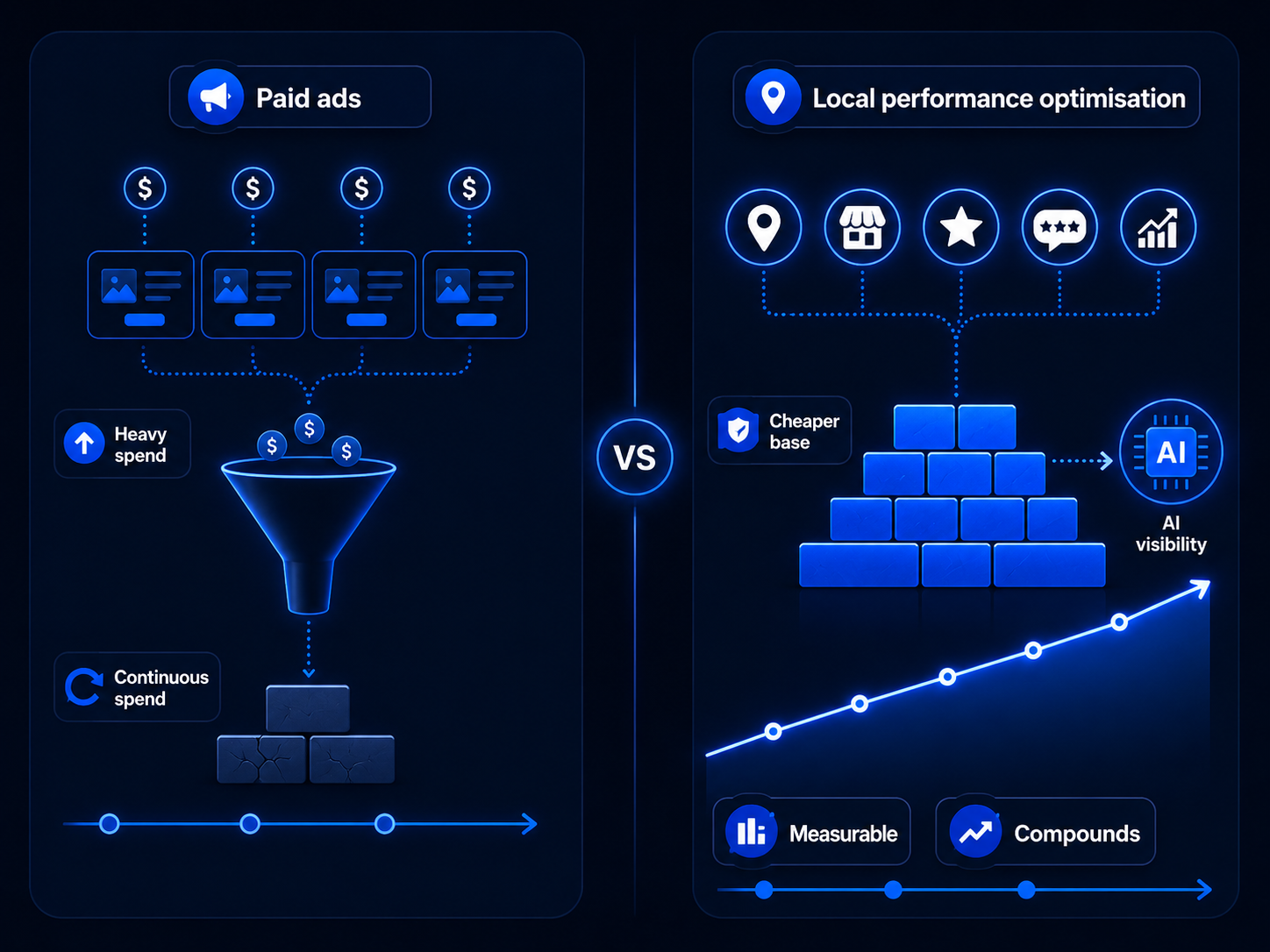
In much of Europe and North America this is already standard: nearly every franchise does it. Here in this region it's still new, and "new" is exactly what makes it a differentiator. It's also comparatively affordable: unlike paid ads, where you have to spend heavily just to build a foundation, this foundation is relatively cheap to lay and it's easy to track and quantify. From an ROI standpoint there's very little argument against it.
And there's a hard-nosed version of the argument too: lost business is a franchisor problem. You want to grow the network and see it succeed, but if your franchisees don't have enough business, that growth doesn't happen. Supporting them to get there ultimately comes back to you. One sustainable way to fund it is a marketing fund (say, a set percentage of franchise revenue) pooled and spent on activities like local performance optimisation and AI-visibility work, similar to how we've structured things with Michelin. Because it's so measurable, you can show franchisees exactly what their contribution buys.
I'll keep the technology point brief, because this is a strategy piece, not a product pitch. When we started this work in 2020, AI wasn't part of the conversation. It just happens that the exact discipline this program is built on (consistent, accurate, well-maintained location information everywhere it appears) is now also what makes AI tools confident enough to recommend your locations. The work we started for Google Maps turned out to be the work that gets a brand recommended by AI. That's a rare thing in marketing: a foundation you build once that keeps paying off as the channels change.
"But my franchisees handle their own marketing": what I'd tell a Thai franchisor
I hear this a lot, so let me answer it directly. If your franchisees each handle their own marketing, you have a network of individual businesses of wildly uneven quality, and no shared story to tell the next franchisee you're trying to recruit. You're also leaving the single most repeatable, most measurable growth lever, local visibility, to chance.
The alternative isn't to take marketing away from your franchisees. It's to give them a floor: a base level of local performance optimisation that every location gets, run centrally, funded fairly, and reported in money. That floor is what makes your offer more competitive, protects you against poaching, and, because it's so easy to quantify, is one of the few marketing investments where the ROI question almost answers itself.
The numbers we can share
I'm careful about numbers, because a lot of what we do sits under confidentiality. Here's what I can share publicly, framed honestly:

- More than 600% growth in Google Business Profile interactions for one Michelin dealer in Bangkok, measured between 2020 and 2025. This was already a solid, sustainable business when we started; we grew its digital presence (Google Business Profile specifically) steadily over those years, and it translated into real, high-volume business.
- Some dealers, at busy times of year, asked us to ease off because they simply couldn't handle the number of customers coming in. (Not the Bangkok dealer above; that one is large enough to absorb the volume.) It's not a metric, but it might be the most honest signal there is.
- One dealer (an example, and an outlier, not a typical result) started at roughly 100 Google Business Profile views per month and passed 30,000 within about 6 to 12 months. I share it to show what's possible when a skeptical store fully commits, not to suggest every business will see anything like it.
- Scale: we started in Thailand in 2020 and now cover most of the Southeast Asian region plus Australia, New Zealand, and up to South Korea, expansion earned market by market, on results.
- Outside Michelin: when we start this work with a new business, we usually (not guaranteed) grow its Google Business Profile by 100–200% within 2–3 months, by deploying the tactics we refined at Michelin scale.
Frequently asked questions
What is franchise marketing?
Franchise marketing is how a franchisor and its franchisees work together to attract customers to individual locations while protecting one consistent brand. In practice it splits into two layers: the brand-level strategy the franchisor sets, and the local, location-by-location execution that actually brings customers through each door. The program above is mostly about that second layer, local visibility, run consistently across an entire network.
What is franchise support?
Franchise support is everything a franchisor provides beyond the license to use the brand: training, operations, and increasingly, marketing. Marketing support (a base level of local performance optimisation every location receives) is one of the most competitive forms of support a franchisor can offer, because it directly affects how much business each franchisee does, and it's easy to measure.
What is the relationship between a franchisor and a franchisee?
At its best, it's a partnership where the franchisor's success depends on the franchisee's. If franchisees don't have enough business, the network doesn't grow. That's why forward-looking franchisors invest in things (like shared local marketing) that make individual locations more successful: it's not charity, it's the mechanism by which the whole network grows.
How do I convince franchisees to adopt a marketing program?
Don't start with a mandate. Start with a few motivated locations, get them to an undeniable, quantified result, and turn that into the case study you show everyone else. We proved this in Thailand first, and it's still how we open the conversation in every new market.
Ready to build this into your franchise?
Every franchise network is different, but the pattern is repeatable: co-design the program with the franchisor, get every layer aligned with material that explains the why, prove it with a few committed locations, and fund it in a way you can measure. If you'd like to talk through what that looks like for your brand, book a Free Strategy Session with Marketing Bear.
The execution layer (running local visibility across all your locations at scale) is what we built OnEveryMap to do; if you want to see where your locations stand today, start with a franchise visibility audit.