Franchise Marketing
Franchise Brand Consistency Without Killing Local Marketing
By Jan RohwederFounder of OnEveryMap · CEO & Founder of Marketing Bear
Insights from Jan, founder of OnEveryMap and CEO & founder of Marketing Bear.
When you franchise a brand, you multiply it. One name, one promise, now running across dozens of storefronts owned by dozens of different people, most of whom have never worked a day in marketing. The customer sees none of that. They see the brand. And whether they trust it enough to walk in, or whether an AI assistant is confident enough to recommend it, comes down to one unglamorous thing: consistency.
In our own 2026 research into Thai franchise brands, we found 124 that were effectively invisible on Google Maps and 2,151 individual locations with no website link on their profile. The usual root cause: no one at the top is governing how the brand shows up, location by location. This piece is about fixing that: what to centralize, what to leave to the floor, and how to train the people in between so consistency never becomes a straitjacket that kills good local marketing.

Why consistency is the whole game
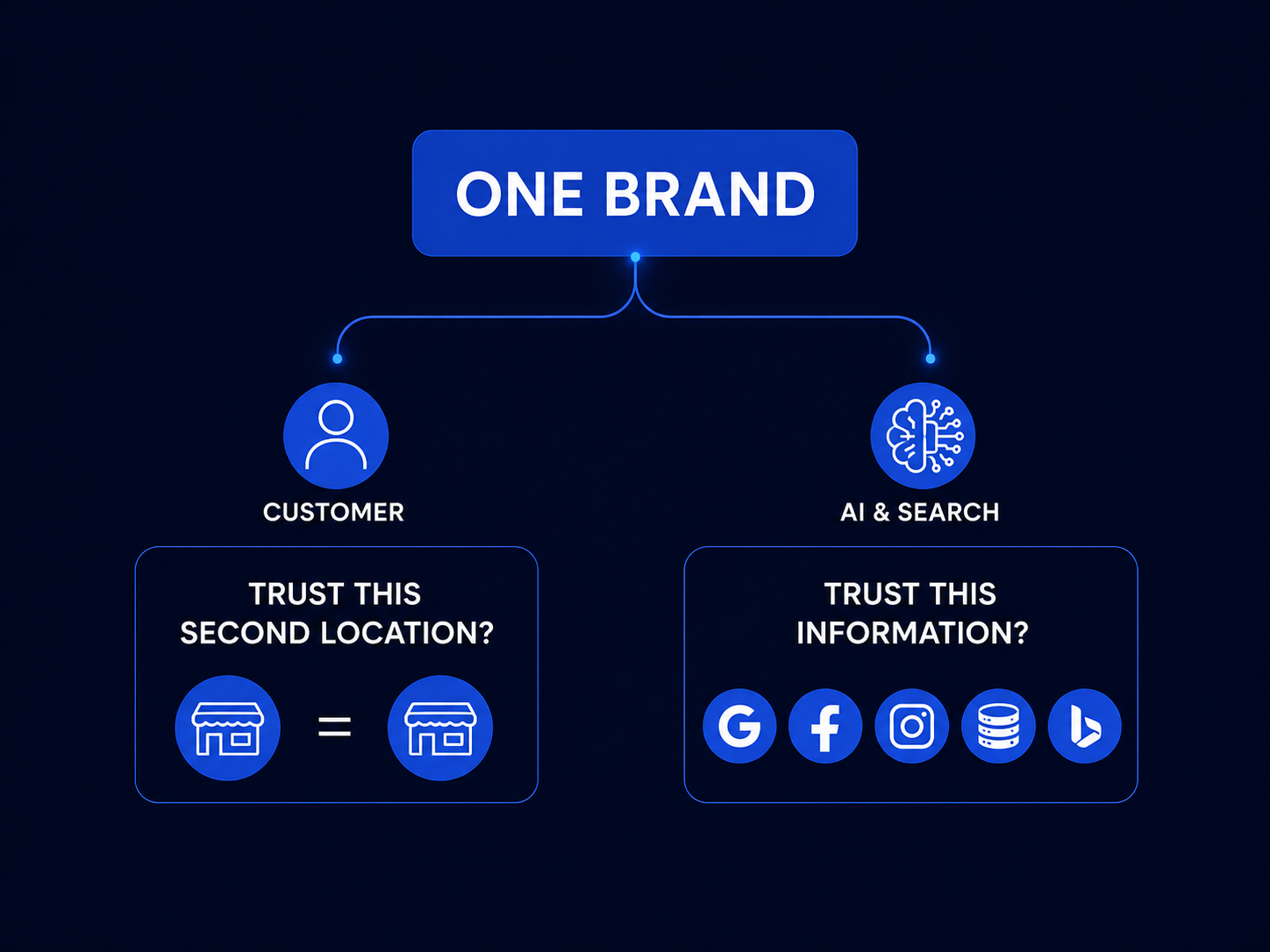
Consistency is not a branding nicety. It is the mechanism by which two very different audiences decide to trust you.
The first is the customer, and this is the part most franchisors underestimate: most consumers do not know, or care, which of your locations is a franchise and which is company-owned. When they see your brand, they think that is the brand. So when someone who loved one location travels to another province, finds your nearest branch on Google Maps, and sees a profile that looks nothing like the one they remember (different photos, thinner information, a neglected page), that disconnect plants a seed of doubt, and doubt sends them to a competitor. That is the hidden cost of inconsistency: business you never see walking away.
The second is the machine. AI tools and search engines recommend the businesses they are most confident about, and consistency is king for that confidence: the same name, categories, and story about who you are, repeated across Google, Facebook, Instagram, the data aggregators that feed the AI models, and even Bing. When it all lines up, you are a known quantity and you get recommended; when every location tells a different story, you starve that confidence. Your Google Business Profile is only the tip of the iceberg; the consistency underneath it is what gets you cited.
What to centralize, and what to leave to your locations
The governance question is not "should we be consistent." Obviously yes. It is: what do we lock down centrally, and what do we let each location adapt?
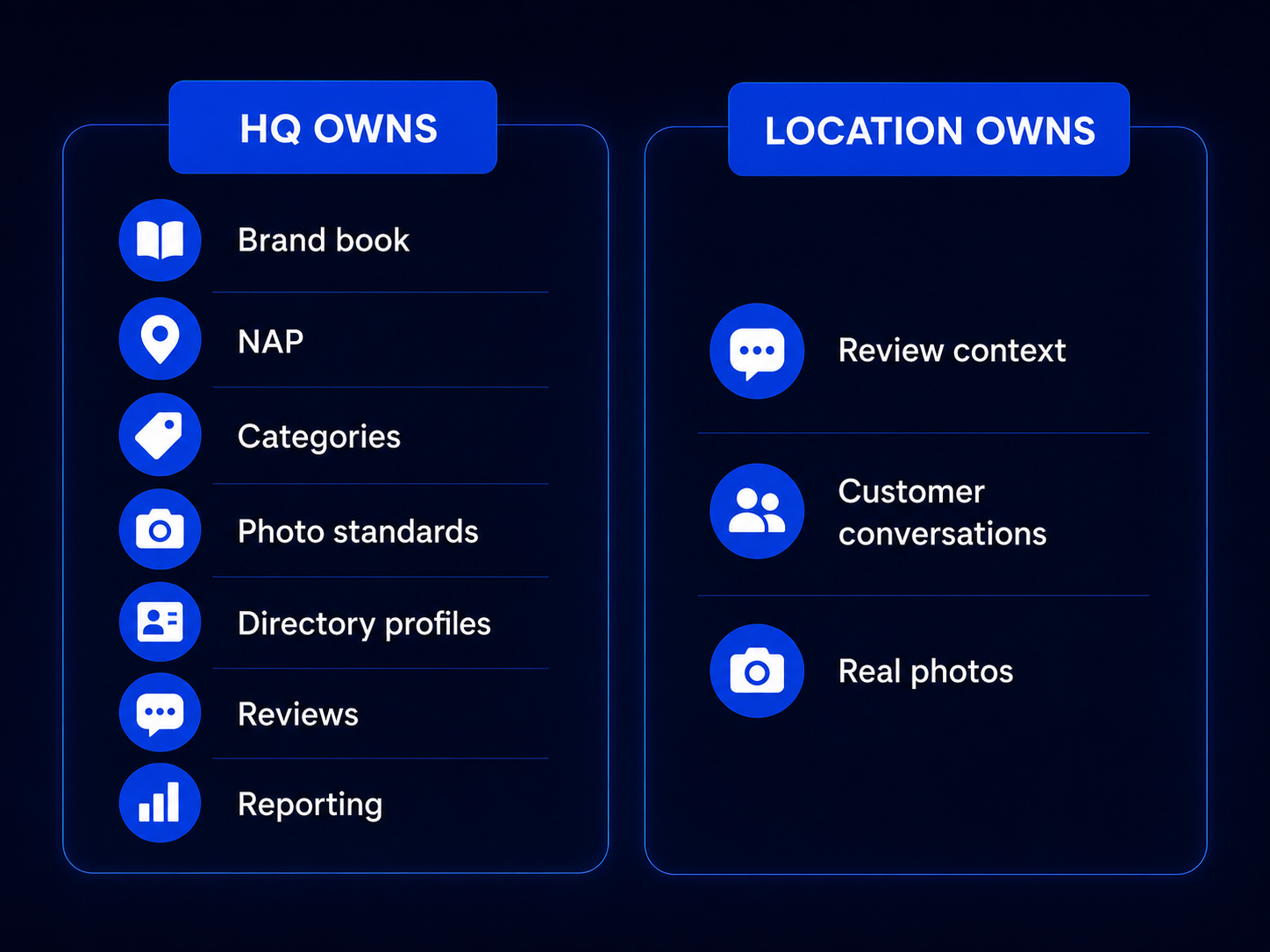
My hard recommendation, learned across a very large network, is that the brand itself and the whole discipline of local visibility should be led and steered by headquarters. The brand book (the single source of truth for name, address, phone, categories, service lists, photo standards, and the profiles across every directory) is HQ's job. Hand all of that to a large, disconnected group of branch managers and franchisees and each one handles it their own way; then you no longer have a brand, you have a logo shared by strangers.
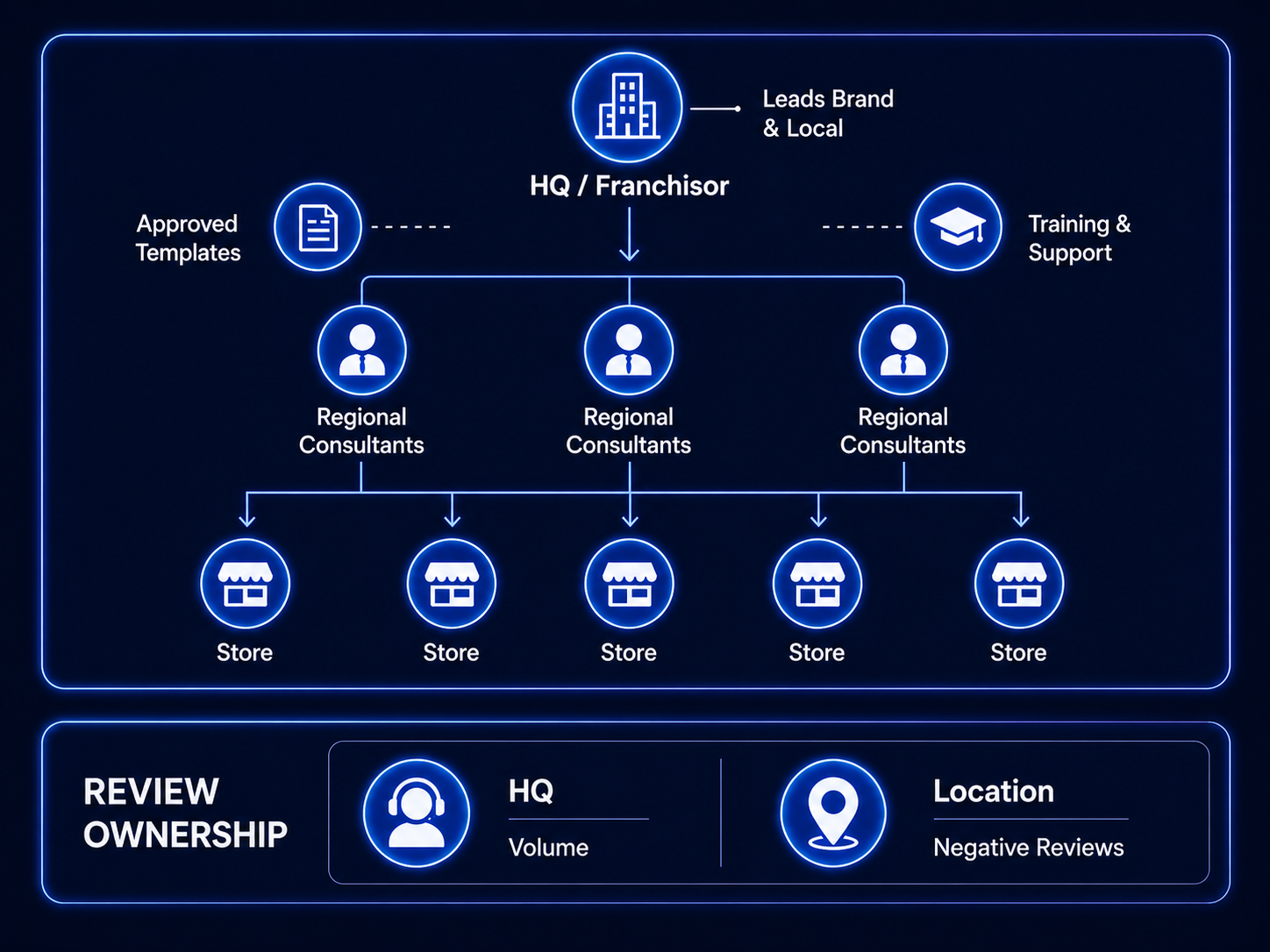
What you leave to the location is the narrow set of things that genuinely need on-the-ground knowledge. The clearest example is negative reviews. HQ should take the sheer volume of review reading and replying off the location's hands (it matters far too much to visibility to leave to chance), but a specific, angry, this-is-what-happened-to-me review has to be answered by the people who were in the room. That split, central control of the brand and local ownership of local truth, is the spine of good franchise governance.
The structure: HQ steers, store consultants carry it to the floor
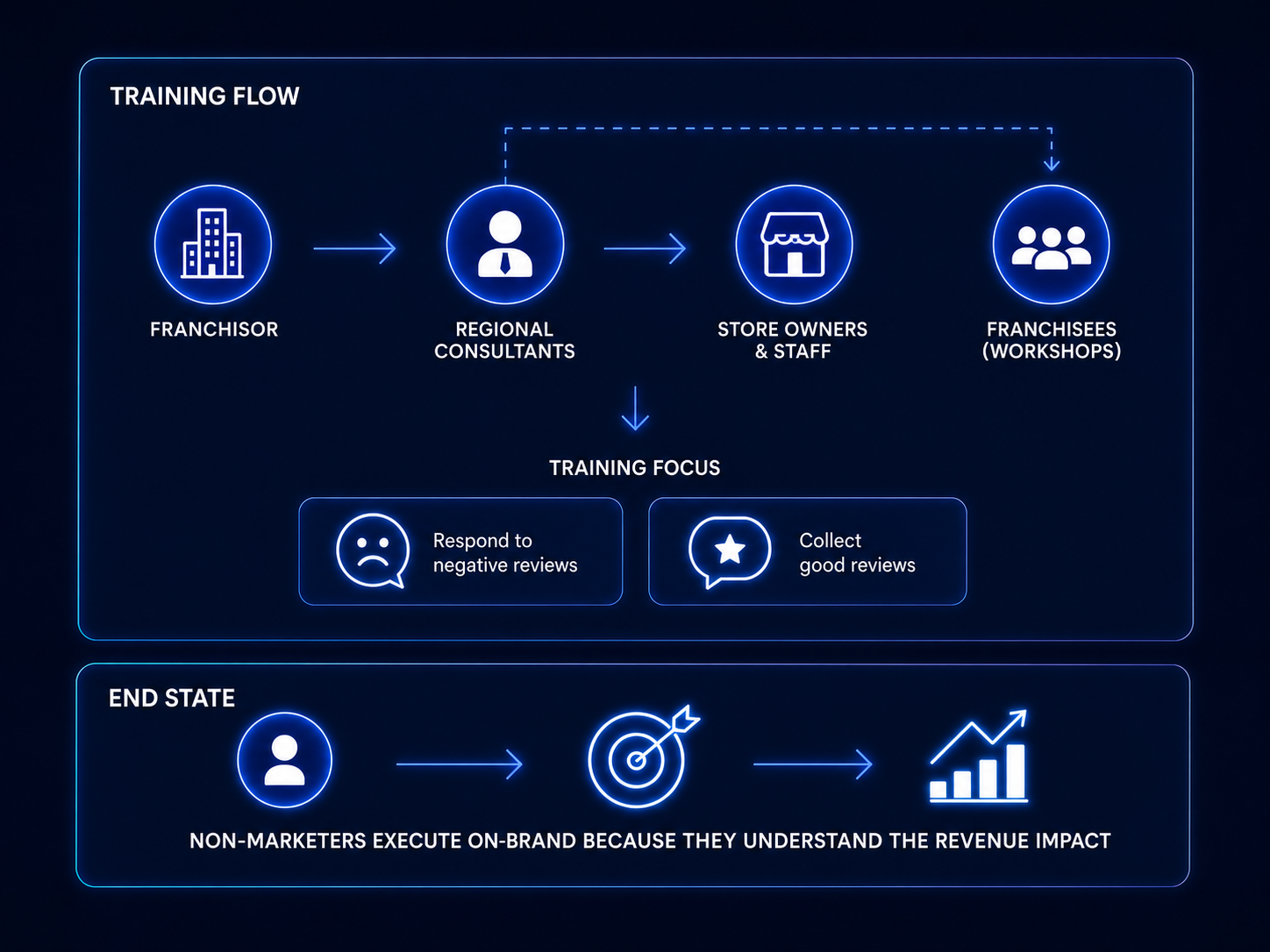
HQ steers, but HQ does not visit every store. The people who carry the brand to the floor are your store consultants: the regional field team who work with the locations in their area. In the Michelin tyre-dealer program we have run since 2020 (started in Thailand, now covering most of Southeast Asia plus Australia, New Zealand, and up to South Korea) the consultants were never the hard part to win over. They are always looking for new ways to help their stores, so a tool that visibly brings in more customers is a gift. But a consultant can only carry a message they have been handed. When that program began, the franchisor (real credit to Craig Burton, who had already built a strong structure before we came in on the execution side) had identified the right tasks, but the training material did not exist yet. Building it (presentations, flyers, one-pagers, approval-ready templates) was one of our biggest unlocks: it made everyone from the regional consultant down to the person in the shop pull in the same direction.
That is what an approval workflow really is: not bureaucracy, but a shared set of pre-approved templates and standards so a location can move fast without going off-brand. Give locations on-brand assets they can adapt (the right post, customized with their store name and number) and you get both local relevance and one connected brand. The fuller version of how this program was designed and adopted is the story in the Michelin playbook, with a measured public write-up in the Michelin Retailers case study.
Training and workshops: governing the human risk
Here is the risk nobody puts in the franchise brochure: the moment you involve store owners, their staff, or franchisees, you are handing brand execution to people who, most of the time, are not marketers. In our program the store owners were superb technicians, some of the best people you could have working on your car, and near-complete beginners at marketing. That is not a criticism, it is a design constraint. You govern it with training, not with hope.
Two things earn their keep. First, train the store consultants deeply, so the people carrying the message can answer the real questions: how to respond to a negative review without being defensive, how to keep a profile on-brand. Where consultants cannot reach every store, bring franchisees and location managers into workshops directly. Second, train the one thing that genuinely cannot be done remotely: review collection. Around 90% of local visibility work can be done centrally; asking a happy customer for a review cannot. The default (QR codes that say "review us") is a poor method: low-efficiency, and it does not steer customers toward the things that help other people choose you or an AI recommend you. Train your staff on how, when, and even whether to ask (you naturally ask the customer who loved the service, not the one having a bad day, which is common sense, not review-hiding), and what to include: the specifics, plus a photo or video if they are willing. That is local content that converts, and the one governance task you cannot centralize.
Throughout, show these owners what consistency is worth in their own revenue. When they see that a well-governed brand presence brings customers through their door, they stop treating the standards as HQ red tape and start protecting them.
Holding the tension between brand control and local ownership
The instinct, once you see the human risk, is to clamp down and centralize everything. Resist it. The goal is not to take marketing away from your franchisees, it is to give them a floor: a base level of brand presence and local visibility that every location gets, run centrally and funded fairly, on top of which they can still act locally where it counts.
Two things keep the balance honest. One is in-person alignment: we are fortunate that our franchisor partner's regional office is in Bangkok, which lets both sides meet face to face in the high-stakes moments where trust and unity actually get built. No dashboard replaces sitting in a room together. The other is remembering who the brand belongs to in the customer's mind: not HQ, not the franchisee, but the name over the door. Govern for that person and the control-versus-freedom argument mostly resolves itself.
Frequently asked questions
What does a franchisor do?
Beyond licensing the brand, a franchisor's job is to protect and grow it across every location, including ones it does not own. In marketing terms that means governing brand consistency: owning the single source of truth for how the brand appears, steering local visibility centrally, and deciding what each location may adapt.
What is the relationship between a franchisor and a franchisee?
At its best, a partnership where the franchisor's success depends on the franchisee's. The franchisor holds the brand and the standards; the franchisee runs the storefront and holds the local knowledge. Brand consistency is where they meet: the franchisor steers how the brand shows up, and the franchisee owns the pieces only someone on the ground can do, like the context behind a specific negative review.
Who should own a franchise's Google Business Profiles, HQ or the franchisee?
HQ should lead and steer it, with locations owning only the parts that need local knowledge. Leaving profile management to a large, disconnected group of franchisees is the fastest way to lose the consistency that customers and AI tools rely on to trust you. Keep the brand-level work central; push the local-truth work to the store, backed by training.
Ready to govern your brand across every location?
Brand consistency is not about clamping down. It is about deciding, deliberately, what HQ steers and what your locations own, then training the people in between so consistency and good local marketing can coexist. If you would like to map that out for your network, book a Free Strategy Session with Marketing Bear, and see the full program story in the Michelin playbook.
When you are ready to run this across every location at scale, the execution layer is OnEveryMap; a franchise visibility audit shows where your locations stand today.