Franchise Marketing
Franchise Lead Generation Strategy: Turn Every Location Into a Lead Engine
By Jan RohwederFounder of OnEveryMap · CEO & Founder of Marketing Bear
Insights from Jan, founder of OnEveryMap and CEO & founder of Marketing Bear.
When a franchise brand asks me about "lead generation," they usually mean one of two things: bring more customers into our locations, or recruit more franchisees. The answer that ties both together is that it is the same engine. A franchise that reliably generates customer leads at every location is, by definition, the most attractive offer a prospective franchisee will ever look at. So a franchise lead generation strategy does not start with a clever campaign or a franchise-sales portal. It starts at the location level, with being found the moment someone is ready to buy.
That is exactly where so many Thai franchise brands are leaking. In our own 2026 research into Thai franchise brands (measured July 2026), we found 124 brands that were effectively invisible on Google Maps and 2,151 individual locations with no website link on their profile. Every one is a lead walking past the door, and a story you cannot tell the next franchisee you are trying to recruit.

What lead generation actually means for a franchise
Search "franchise lead generation" and you get two worlds: generating customers for the locations you already have, and franchise sales, recruiting the franchisees who open the next locations. Most articles pick one. Hold both, because they are the same problem in sequence: customer leads at the location level are the raw material of franchisee leads at the network level. When a prospect compares your brand against three others, the deciding factor is rarely the brochure; it is one question: will your system actually bring me customers? So build from the ground up. Get the location lead engine right first, and the franchisee pitch takes care of much of itself.
Your leads are created at the moment of intent
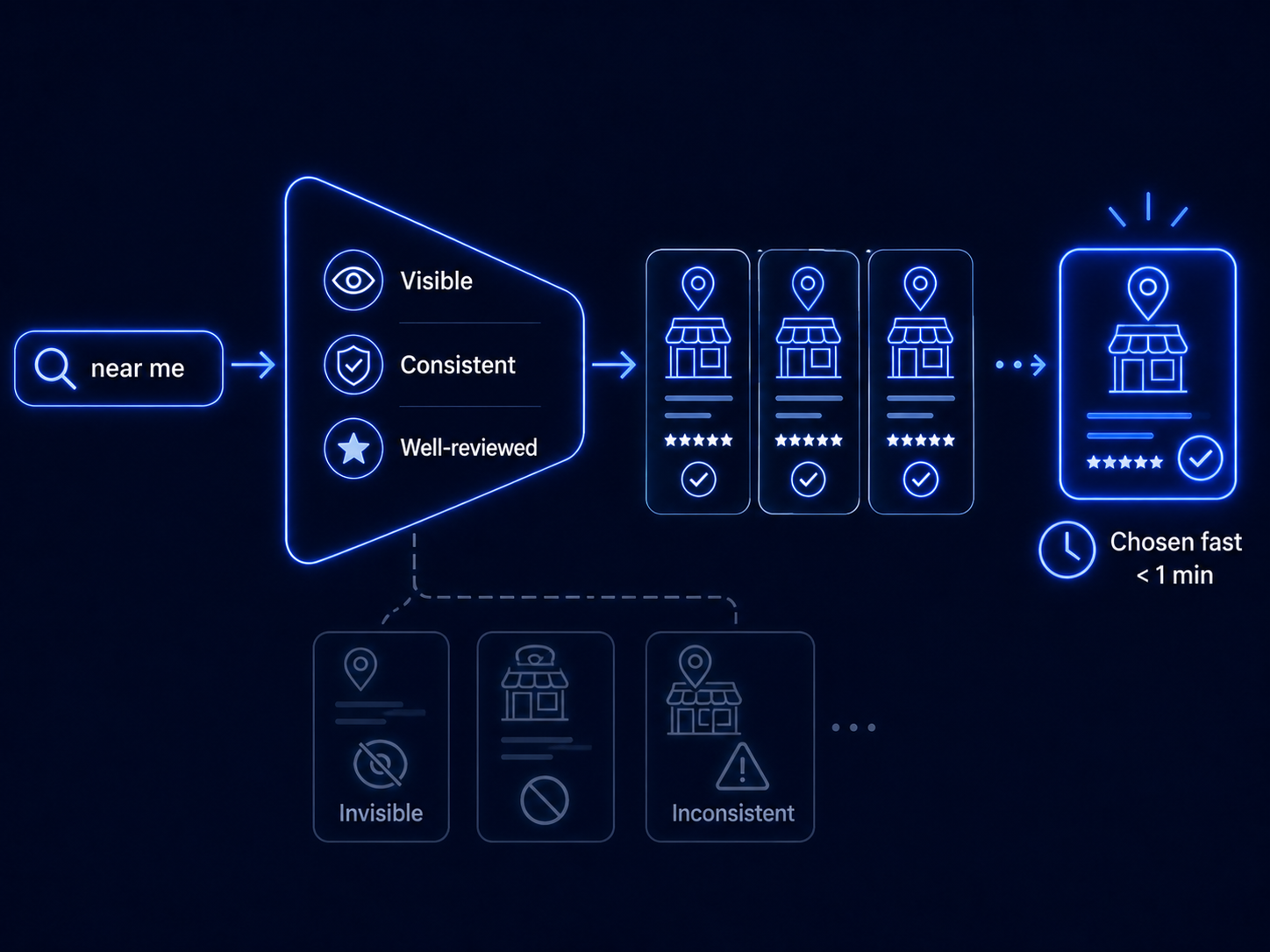
For any business people discover rather than research for weeks, the lead is created in the seconds between "I need this near me" and "I will go here." Think of the categories: food, a quick everyday service, health you do not want to wait for, anything to do with your car when it breaks down, a hotel for the weekend. Nobody spends a month researching where to fix a flat tyre. They search, look at what comes up, and choose within a minute. If your location is not there at that moment, current, consistent, and trusted, the customer picks the competitor who is. That is the hidden cost most multi-location brands miss: they treat a Google Business Profile as a box ticked once, so people can navigate to a store they already know. But a profile set up and forgotten only appears for someone searching your exact name. It is invisible to everyone searching for what you sell.
Three levers turn that moment into a lead:
- Visibility so you appear when someone searches for what you offer nearby, not just for your brand name.
- Consistency so the same accurate information appears everywhere the internet reads about each location. Search engines, and increasingly AI tools, trust a location more when every source agrees, and a customer who had a good experience at one branch trusts the next when it looks like part of the same brand.
- Reviews because they are both a ranking signal and the most persuasive thing a stranger reads before choosing you.
Measure leads per location, or you are guessing
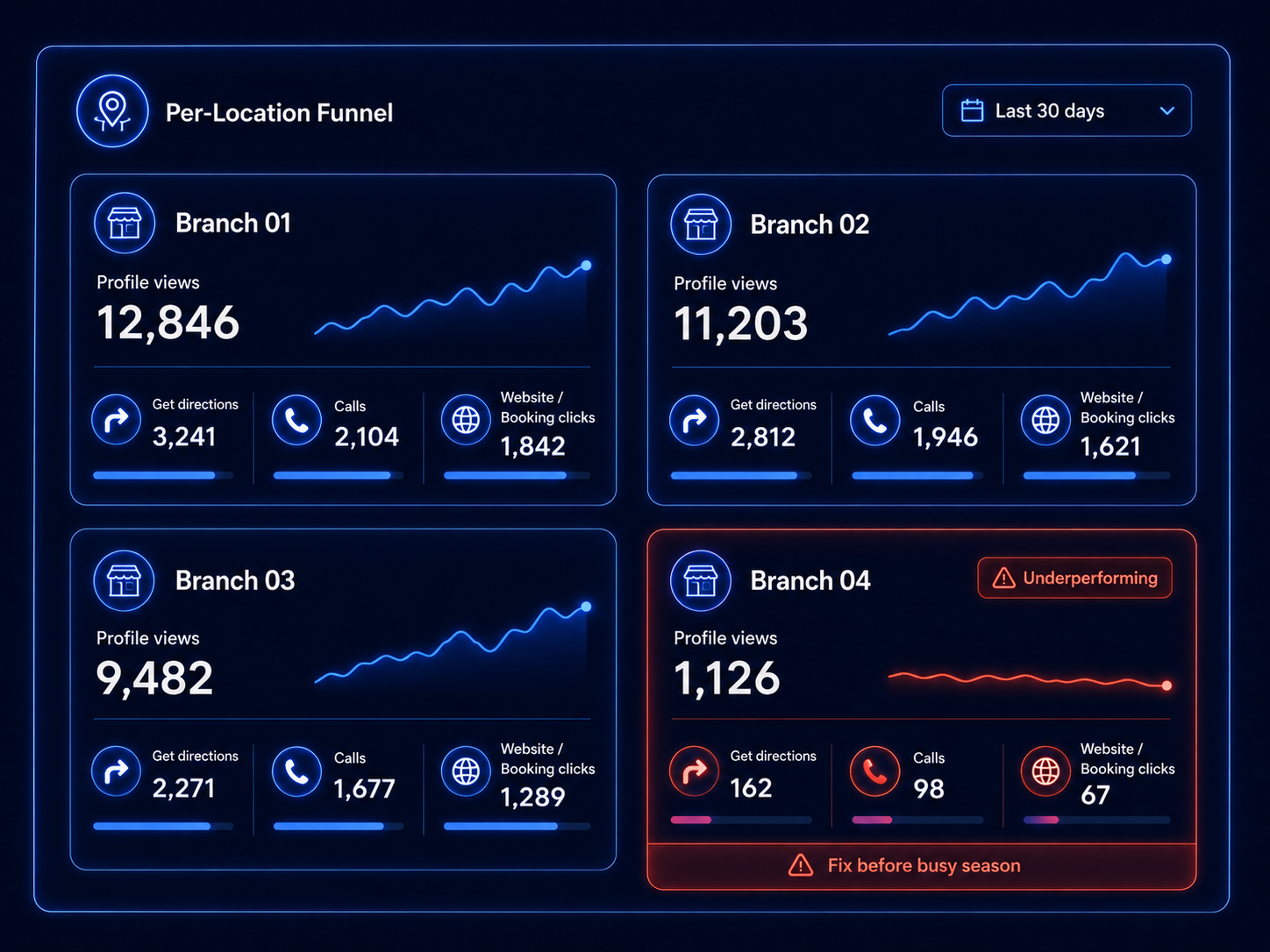
Here is where franchisors get stuck: they see the network at the top level but cannot tell you how any single location performs, or where its leads come from. You cannot scale a lead engine you cannot measure. The fix is per-location measurement: for each store, how do people find it, and are they tapping "get directions," calling, or clicking through to book. That funnel view, which we built for a large franchise network, turns "we do some local marketing" into "we know what each location earns from it," and catches the branch that is quietly invisible before it costs you a season. This is the operations layer; it is worth measuring where your locations stand today before anything else.
Proof that visibility converts into leads
I am careful with numbers, because much of our work sits under confidentiality. But there is a clear public proof point, and it is about leads specifically. Across the Michelin tyre and auto-service retailer network, keeping listings actively managed and engaging with reviews drove 25% more local leads, 29% more calls, and 21% more "Get Directions" requests across the stores.
That is the location lead engine working at network scale, in exactly the discovery-driven category above. A few more things I can share from this program, which we started in Thailand in 2020 and now cover across most of Southeast Asia plus Australia, New Zealand, and up to South Korea: interactions on one Bangkok dealer's Google Business Profile grew more than 600% between 2020 and 2025. And at busy times of year, some dealers actually asked us to ease off, because they could not handle the customers coming in. That is not a chartable metric, but it may be the most honest signal there is of what a maintained location presence does to demand.

The payoff: a proven location lead engine is your strongest franchisee pitch
Now the second meaning of "lead generation": recruiting franchisees. A franchisee today has options, so ask why someone would choose your offer over a competitor's, and how you stop them being poached later. You answer both by increasing the value you provide. For any business that depends on foot traffic, a base level of local visibility work, run centrally and reported in money, is a concrete form of that value. It is the difference between telling a prospect "we have a strong brand" and showing them what your average location earns from customers who find it on their phone. Three things make this a real differentiator in this region right now:
- It is still new here. In much of Europe and North America, centrally run local marketing is standard. Here it is not, and "not standard yet" is what makes it a wedge against competitors' offers.
- It is affordable and measurable. Unlike paid ads, where you spend heavily to build a foundation and lose it the moment you stop, this foundation is cheap to lay and easy to quantify, which is what a cautious prospect wants to see.
- It is easy to fund fairly. A marketing fund, a set percentage of franchise revenue pooled and spent on local visibility, lets you show every franchisee what their contribution buys in leads.
The best franchise-sales asset is not a brochure. It is evidence that your locations get found and get chosen.
Frequently asked questions
What is lead generation for franchise sales?
It is how a franchisor attracts and qualifies prospective franchisees. The most persuasive input is not advertising; it is proof that your existing locations reliably generate customers. Build a measurable location lead engine first, and it becomes the centrepiece of every franchise-sales conversation.
How do franchises generate leads for their locations?
By being found at the moment of intent: every location visible when people search for what you sell nearby, consistent and current everywhere it appears, with genuine reviews. "Set up once and forgotten" is not enough; the leads go to whichever competitor maintains that presence.
Do I need a franchise lead generation company or a lead portal?
They can add volume, but they do not answer what a prospect is really asking: does your system bring customers to a location. Get the location lead engine and per-store proof in place first; that is what makes any franchise-sales channel you add on top actually convert.
Ready to build your franchise lead engine?
The pattern is repeatable: make every location findable and consistent, measure the leads per store, prove the ROI, then let that proof do the heavy lifting when you recruit. To map out what that looks like for your brand, book a Free Strategy Session with Marketing Bear.
This piece is one part of a bigger story. For the full picture of how we built and scaled a franchisee-marketing program with a global franchisor, read the Michelin playbook.
The execution layer (running local visibility across all your locations at scale, and measuring the leads each one drives) is what we built OnEveryMap to do. To see where your locations stand today, start with a franchise visibility audit.