Franchise Marketing
Franchisee Marketing Support Models: What HQ Should Centralize, and What the Franchisee Owns
By Jan RohwederFounder of OnEveryMap · CEO & Founder of Marketing Bear
Insights from Jan, founder of OnEveryMap and CEO & founder of Marketing Bear.
"My franchisees handle their own marketing." I hear this from Thai franchisors more than almost anything else. But the moment you leave every location to fend for itself, you get a network of uneven quality and no shared story to tell the next person you are trying to recruit.
This is a guide to the other path: a franchisee marketing support model, where headquarters gives every location a floor of marketing it can rely on, funded fairly and run consistently. I will draw on the franchise dealer program we have run with Michelin's tyre and auto-service retailer network since 2020, but the model transfers to any brand whose locations depend on being found.
Why this is urgent here: in our own 2026 research into Thai franchise brands (measured July 2026), we found 124 brands effectively invisible on Google Maps and 2,151 individual locations with no website link on their profile. Each one is a customer walking past a door.

The full origin story of that Michelin program lives in our Michelin playbook pillar. Here I focus on the model itself.
Start with the split: what HQ centralizes and what the franchisee owns
Every support model turns on one decision: who owns what. The instinct is to hand marketing to the people closest to each location, the branch or franchise managers. In practice, that is where brand consistency goes to die: if forty managers each run their own profiles and messaging, you get forty versions of your brand, and both customers and AI tools lose confidence in who you are.
So my hard recommendation is a clear split: HQ leads and steers the visibility work; the franchisee owns only the pieces that genuinely need local knowledge.
Centralize at HQ: location data (name, address, phone, categories, attributes, correct map pins), profile management, cross-directory consistency, review monitoring, reporting, and the shared budget. These are repeatable and consistency-critical, and should never hinge on whether a busy owner remembered to update their hours.
Leave with the franchisee: the few things only the person on the floor can do well. Replying to tricky or negative reviews, where only they know what happened, and collecting reviews from happy customers in person. Both work far better backed by training than left to chance.
How to fund it: the marketing fund
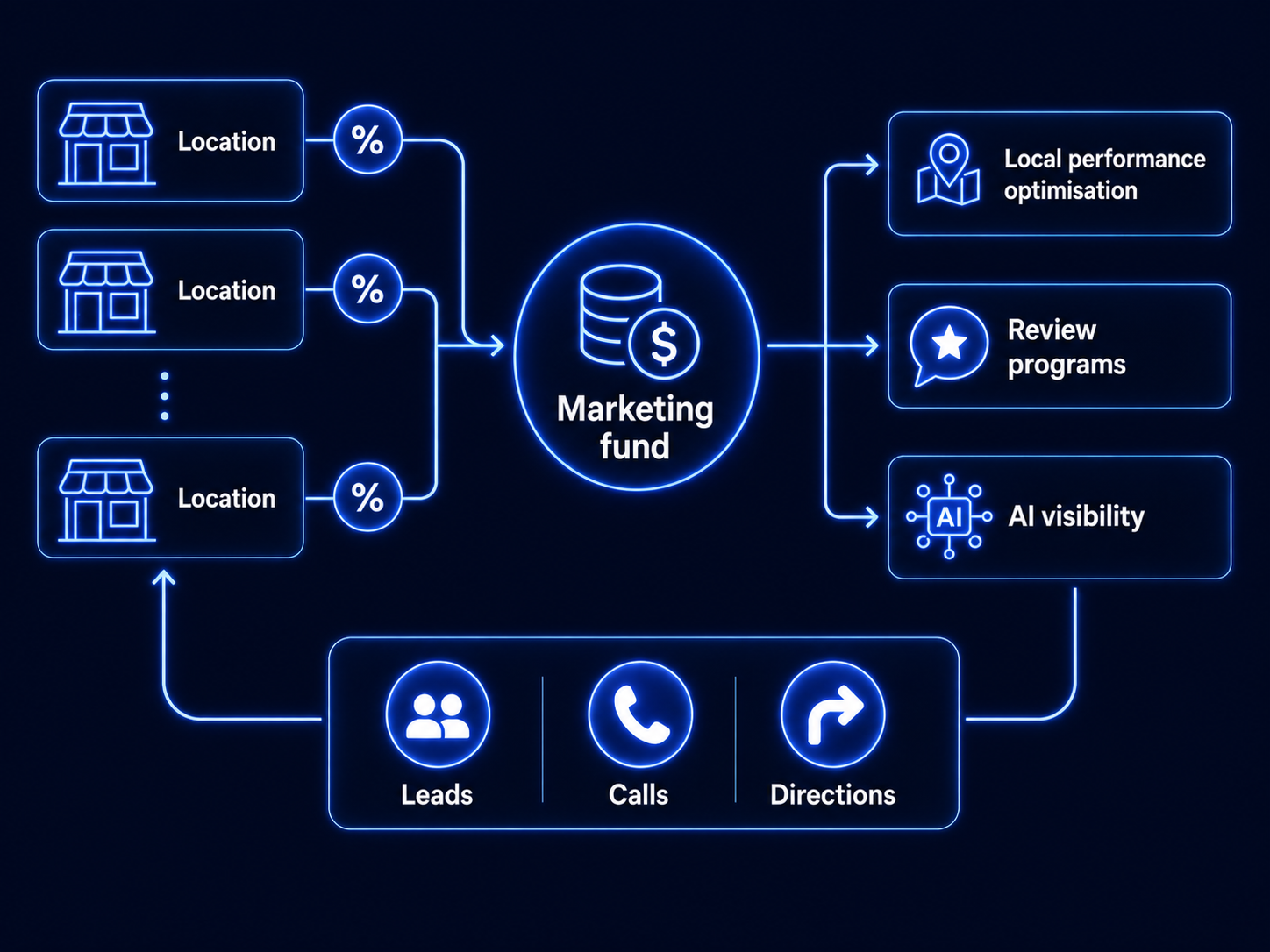
None of this runs on goodwill. The sustainable way to pay for a support model is a marketing fund: a set percentage of franchise revenue, pooled centrally and spent on activities every location benefits from, such as local performance optimisation and, increasingly, AI-visibility work.
A fund does three things at once. It makes support predictable, rather than a favour HQ grants when there happens to be budget. It spreads the cost, so no single location carries it. And because this marketing is so measurable, you can show each franchisee exactly what their contribution buys, in leads, calls, and directions requests, not vague brand goodwill. That transparency turns a fee into something franchisees defend rather than resent.
Training is the real unlock
If I could underline one lesson from years of this work: the task list is not what scales a program. The enablement material is.
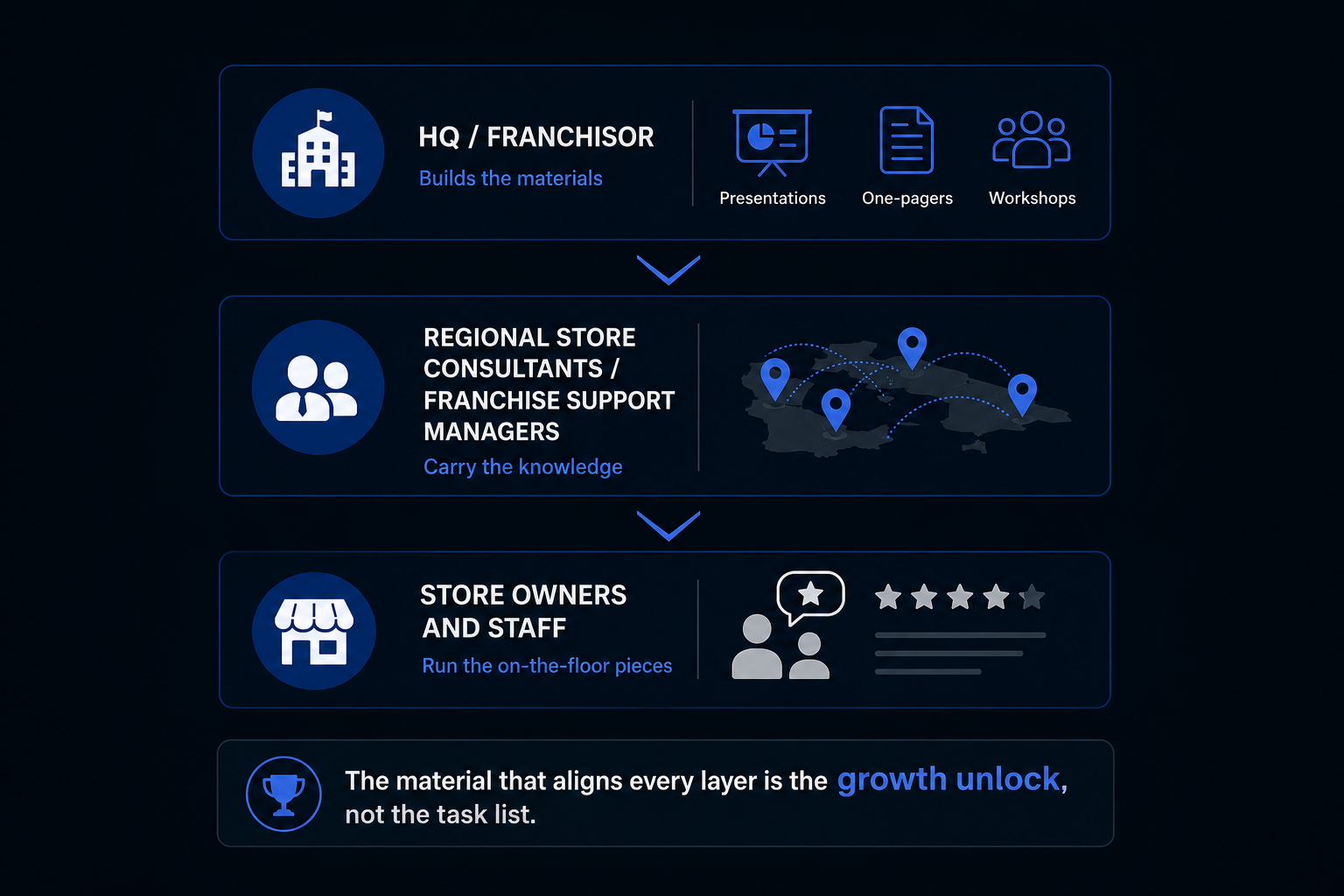
When we built the Michelin program, the tasks were identified early. (Credit to Craig Burton, the marketing manager who brought us in and had already built a strong structure for it.) What did not yet exist were the training materials for their store consultants, the regional field team who carry knowledge to each location. Building those (presentations, one-pagers, workshops), so everyone from the consultant down to the person asking for a review understood the why, is what unlocked heavy growth. Get every layer pulling in one direction and the tasks take care of themselves.
This is where a franchise support manager, or store consultant, earns their keep. They are rarely the hard sell; field teams welcome a tool that visibly brings their stores more customers. Their job is to translate the central program into each store's reality, and good franchise training is what lets them.
Involving store staff carries a risk worth naming: most are not marketers, and one weak habit repeated across a network does real damage. Take review collection. Sticking QR codes around the store that say "review us" collects poorly. (We tested creative flyer and giveaway versions at scale; the measurable lift was close to nothing.) What works is a trained team member who asks the right customer at the right moment and knows what a useful review looks like. That is a training problem, not a signage problem.
The case-study method: prove it on a few committed locations
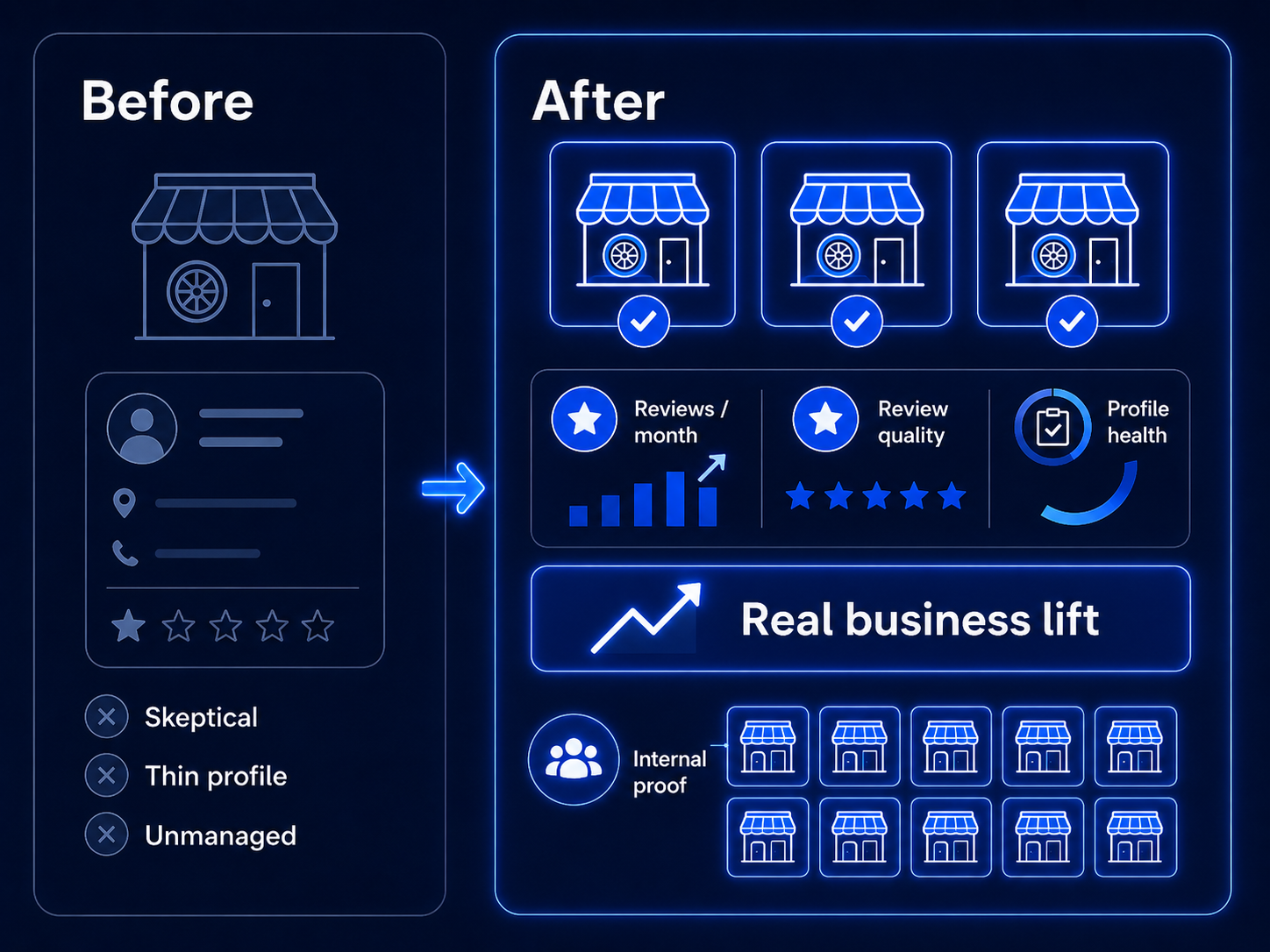
The hardest audience in any franchise is not the field team. It is the store owners. They are often brilliant at their trade with almost no marketing background, so "get more reviews" sounds like a vanity project, not a growth lever. And it is a long-term, compounding one, hard to sell to someone with a full day of work in front of them.
The method that worked, we found in Thailand first. Instead of converting the whole network with a slide deck, we picked a few already-motivated locations, tracked them closely (how many reviews, what they said, how well they responded, whether the profile was correct), and quantified how it translated into actual business. A few believers became undeniable proof, and that proof convinced nearly all the other dealers to follow.
If you take one tactic from this article, take this one. Do not mandate. Prove it on a few committed locations, quantify the result in money, and let that become the story you tell everyone else. Thailand is our reference market for exactly that reason: we pilot here, then carry the evidence into new markets.
Why marketing support makes your franchise offer harder to leave
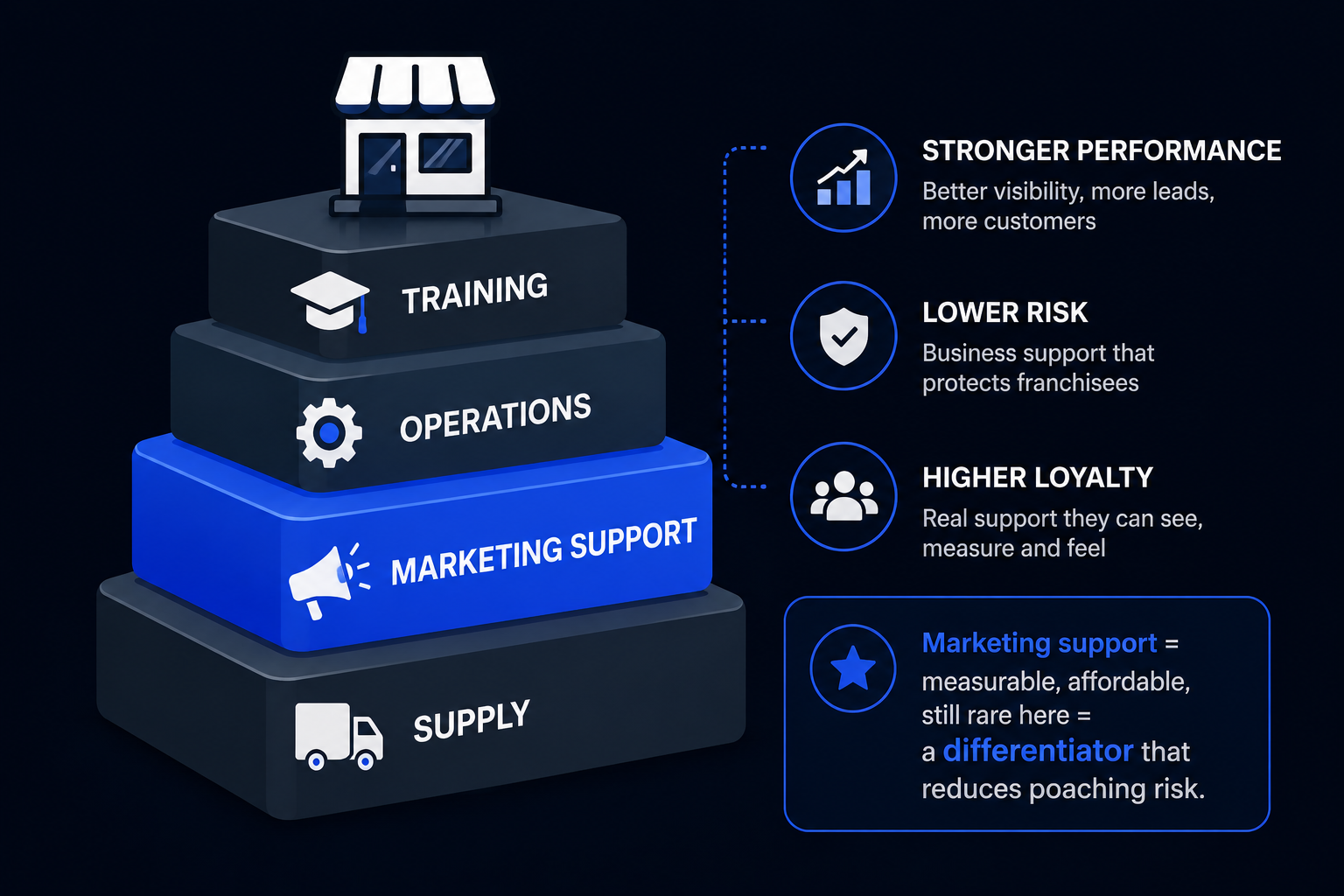
Here is the strategic payoff, and why marketing support is a franchisor's concern, not only a franchisee's. A franchisee today has options. The question to sit with: why would someone choose your offer over a competitor's, and how do you keep them from being poached later?
You reduce that risk by increasing the value you provide. A base level of marketing that measurably brings each location more customers is one of the most concrete forms of value a franchisor can add. In Europe and North America it is already standard; here it is still new, which is exactly what makes it a differentiator. It is also affordable: unlike paid ads, which need heavy continuous spend just to hold a position, this foundation is cheap to lay and it compounds.
One cleared number from the Michelin program shows the ceiling: interactions on one Bangkok dealer's Google Business Profile grew by more than 600% between 2020 and 2025. Some dealers, at peak season, have even asked us to ease off, because they could not handle the volume of customers coming in. When your support does that for a franchisee, leaving for a competitor stops being an attractive idea.
Frequently asked questions
What is franchisee marketing support?
Everything a franchisor does to help individual locations attract customers while protecting one consistent brand. HQ runs the repeatable, consistency-critical work centrally (location data, profiles, reporting, budget), and franchisees own only what needs local knowledge, like replying to negative reviews and collecting reviews on the floor.
What is a franchise support system?
The structured set of resources a franchisor provides beyond the brand license. For marketing it has five parts: a clear HQ-versus-franchisee ownership split, a funding mechanism (a marketing fund), enablement through training, proof through case studies, and reporting that shows the value in money.
What should franchise support services include?
Traditionally training, operations, and supply. Marketing now belongs on that list, because it directly affects how much business each franchisee does and, unlike most support, is easy to quantify. A base level of local marketing every location receives is one of the most competitive forms of support a franchisor can offer.
What does a franchise support manager do?
A franchise support manager, often a regional store or field consultant, carries the central program into each location: translating HQ's approach into each store's reality and training owners and staff on the few things only they can do, like collecting reviews well. In our experience these field teams are rarely the hard sell.
How big should a franchise marketing fund be?
There is no single right number; it depends on your margins and network. What matters is structure: set it as a defined percentage of franchise revenue, pool it centrally, spend it where every location benefits, and report back exactly what each franchisee's contribution earned.
Ready to design your support model?
The pattern is repeatable: split ownership so HQ steers and franchisees own the local pieces, fund it with a marketing fund, train every layer on the why, and prove it on a few committed locations before you scale. If you would like to talk through what that looks like for your brand, book a Free Strategy Session with Marketing Bear.
The execution layer, running local visibility across all your locations at scale, is what we built OnEveryMap to do. If you want to see where your locations stand today, start with a franchise visibility audit.